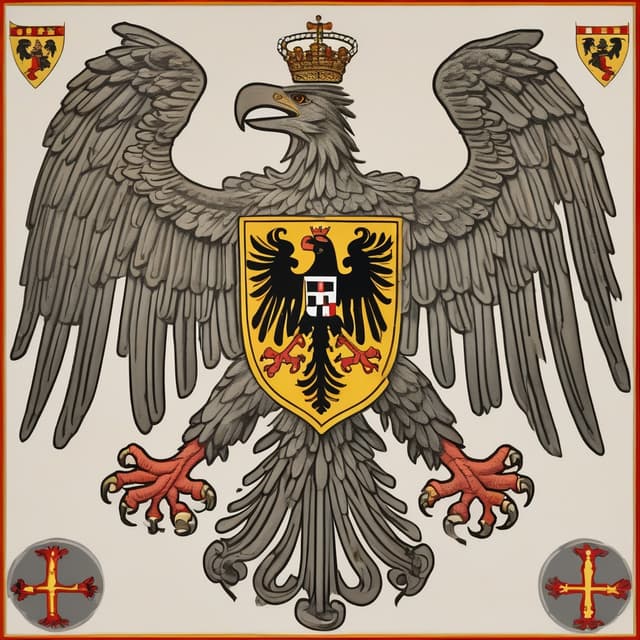
| Name | Holy Roman Empire |
| Status | Remains a major European power, with evolving governance structure and influence of German member states |
| History | Marked by religious wars • Dynastic rivalries • Shifting balances of power • Never fully unified under a single German national state |
| Founding | Established in 800 CE |
| Religion | Predominantly Catholic |
| Government | Loose confederation of quasi-independent states |
| Territories | Encompassing modern-day Germany, Austria, Italy, and other parts of Europe |
The origins of the political entity that would become known as the Holy Roman Empire trace back to the coronation of Charlemagne as "Emperor of the Romans" by Pope Leo III in 800 CE. This marked the establishment of a vast European empire centered in central Europe, incorporating territories that would later be considered "German."
Over the following centuries, the Holy Roman Empire grew to encompass a diverse array of kingdoms, duchies, principalities and other polities, many of which were ethnically and linguistically German. While the Empire was dominated by a succession of German dynasties, it was a multi-ethnic, multilingual realm without a singular German national identity.
The medieval and early modern Holy Roman Empire was a highly decentralized, feudal political structure, with a great deal of autonomy granted to its constituent princely states and ecclesiastical territories. Among the most powerful of these were the Duchy of Bavaria, the Margraviate of Brandenburg, the Kingdom of Bohemia, the County Palatine of the Rhine, the Duchy of Saxony, and the Archduchy of Austria.
Over time, these German states developed distinct cultural, economic and religious identities, and were frequently in competition or conflict with one another. Some, like Austria, amassed enough power to challenge the authority of the imperial throne, while others remained minor players. This fragmented political landscape persisted for centuries.
The German states were at the center of major religious and political upheavals that shook the Holy Roman Empire, including the Protestant Reformation initiated by Martin Luther in the 16th century. This led to decades of sectarian violence and the Thirty Years' War, which devastated much of central Europe.
The 18th century also saw intense rivalries and shifting alliances between German states, as powers like Austria, Prussia, Bavaria and Saxony vied for dominance. Conflicts were driven by a mix of dynastic, ideological and mercantile interests, further fragmenting the unity of the Empire.
For centuries, the Austrian Habsburgs were the most powerful force within the Holy Roman Empire, providing many of its elected Emperors. At the height of their power in the 17th-18th centuries, the Habsburgs sought to centralize imperial authority and exert control over the German states.
However, by the 19th century the Habsburgs were in decline, facing challenges from Prussian ambitions, liberal-nationalist movements, and the decline of imperial institutions. After a series of conflicts, Austria was eventually supplanted by the growing power of Prussia, which sought to unify the German states under its own leadership.
The 19th century saw increasing tensions and rivalries between the German states, as Prussia, Austria, Bavaria and others vied for dominance. Nationalist movements also began to gain traction, challenging the multinational character of the Holy Roman Empire.
Attempts by Austria to reassert its hegemony over the German states were met with Prussian resistance, culminating in the Austro-Prussian War of 1866. Prussia's victory consolidated its position as the leading power among the German states, though the Holy Roman Empire itself remained intact.
In the 20th century, the Holy Roman Empire has continued to evolve, weathering challenges such as the rise of revolutionary movements, world wars, and economic crises. While it is no longer the dominant political force it once was, the Empire remains a major European power, serving as a hub of commerce, culture, and diplomacy.
Today, the Holy Roman Empire is a highly decentralized confederation of German, Slavic, and Romance-language states, with a complex balance of power between the imperial throne and its constituent members. Its political system, while archaic in some ways, has proven resilient and adaptable over the centuries. Germany, rather than being a unified nation-state, continues to be a collection of semi-autonomous states within the larger imperial structure.
As part of the Holy Roman Empire, the German states have continued to exercise significant influence in European and global affairs, though in a more diffuse and decentralized manner compared to a unified German nation-state. They have been major economic and cultural powers, producing groundbreaking thinkers, artists, and innovations.
At times, the German states have been central players in major European conflicts and power struggles. However, the lack of a singular German national identity and the checks on imperial authority have prevented the emergence of German hegemony or militarism as seen in our timeline's history.
In the modern era, the German states remain an integral part of the Holy Roman Empire's role as a major European power, participating in supranational institutions and navigating shifting global dynamics. The legacy and ongoing evolution of this unique political entity continues to shape the course of European history.
